Antola Park

Edited by:
Massimo Martini
Access
The Antola Regional Nature Park can be reached via two main routes, corresponding to the two valley systems in the area. On the Valle Scrivia side, the main route is the [A7] Genoa–Milan motorway, which offers three useful exits: Busalla — where the park office is located — Ronco Scrivia and Isola del Cantone. From these junctions, you can take the dei Giovi state road, which runs along the valley floor, and the Valle Scrivia provincial road, which leads into the western part of the area. To reach Val Vobbia, turn off the towards Vobbia. To reach the Val Trebbia side, the main access route passes through Torriglia, which can be reached from Genoa via the Val Trebbia state road ; the innermost hamlets of the park in the upper Val Trebbia — Montebruno, Propata, Rondanina, Fascia, Gorreto — can be reached by continuing along the towards Piacenza.
The park’s visitor centre and scientific hub is based at the Torriglietta building in Torriglia; the Park Authority’s administrative headquarters are in Busalla. Rail services to the Valle Scrivia side are provided by the narrow-gauge Genoa–Casella railway, operated by AMT Genoa, which connects the provincial capital to Casella with stops in the towns of the middle valley; there is no rail link to the Trebbia Valley. Public road transport provides daily services from Genoa to Torriglia and the main towns in the upper Trebbia Valley. The nearest airport is Genoa Cristoforo Colombo.
Introduction
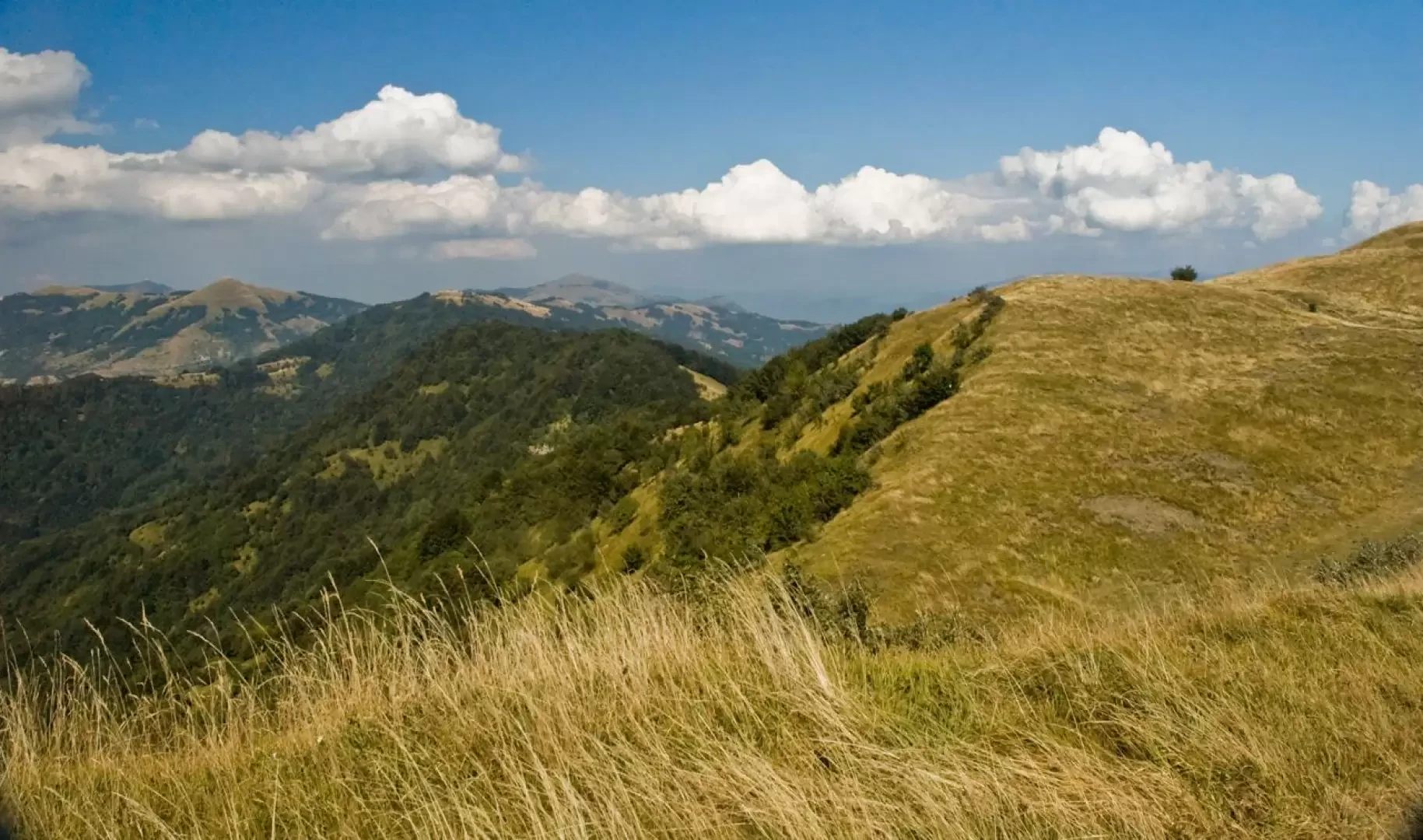
The Antola Regional Nature Parkis a protected area in Liguria, established in 1995, which safeguards a territory of approximately 48.37 km² in the Genoa hinterland, falling entirely within the metropolitan city of Genoa. The park occupies the Po Valley side of the Apennine watershed in the stretch between the Scrivia Valley to the west and the Trebbia Valley to the east, with altitudes rising to 1,597 m at Mount Antola, the highest peak in the area. The landscape is typical of the northern Ligurian Apennines: wooded ridges, narrow and deep secondary valleys, and open high-altitude grasslands. The area boasts a high level of biological diversity, where sub-Mediterranean ecosystems and continental environments coexist at closely spaced altitudes and on neighbouring slopes; this variability has enabled the conservation of plant and animal species of scientific interest. The spring blooms on the ridges — daffodils (Narcissus poeticus), orchids, gentians — and the presence of the Apennine wolf (Canis lupus italicus), which has returned to permanently inhabit the area, are the park’s most recognisable natural features.
Description
The park’s territory is centred on the orographic hub of Mount Antola, which acts as a watershed between the area’s two major valley systems. Secondary valleys branch off from this same ridge: the Vobbia Valley and the Brevenna Valley — together with the Pentemina Valley — flow into the Scrivia; whilst the Brugneto, Cassingheno and Terenzone basins feed into the Trebbia river system. Over the centuries, this crossroads position between distinct river basins has made Mount Antola a key commercial and geographical reference point for the communities on both sides.
Geologically, the western sector of the park is characterised by the outcrop of the Savignone conglomerate, an Oligocene formation which, in the Rocche del Reopasso, creates a rocky landscape with vertical cliffs that is morphologically distinct from the rest of the area. This same substrate is home to a remarkable rock-dwelling flora in the Val Vobbia, including species rare in Liguria such as the fern Asplenium fontanum. Lake Brugneto, an artificial reservoir built in 1959 in the Val Trebbia area, is the main water supply for the city of Genoa and constitutes the park’s fifth most recognisable natural feature; the Brugneto Lake Loop is one of the most popular hiking trails in the area.
The vegetation follows a distinct altitudinal distribution. Below 1,000 m, the woodland zones are dominated by oaks — Turkey oak (Quercus cerris), sessile oak (Quercus petraea) and downy oak (Quercus pubescens) — supplemented by sweet chestnut (Castanea sativa), mostly reduced to coppice; along watercourses, grey alder (Alnus incana) and poplars appear. Between 1,000 and 1,500 metres, the beech (Fagus sylvatica) is the dominant species and forms extensive beech forests on the northern slopes; above 1,500 m, the summit grasslands open up around the peak, with rowan (Sorbus aucuparia) as the only tree species. The flora on the ridges is particularly rich in spring: the grasslands around Antola are home to daffodils (Narcissus poeticus), golden(Trollius europaeus), orchids (Dactylorhiza sambucina), arnica (Arnica montana) and greater gentian (Gentiana lutea); in the clearings on the slopes, one finds the red lily (Lilium bulbiferum) and the martagon lily (Lilium martagon).
Among the mammals, the species of greatest conservation interest is the Apennine wolf (Canis lupus italicus), which has returned permanently to the area after an absence of over a century. Its main prey in the area are the fallow deer (Dama dama), which is the subject of a management plan, and the roe deer (Capreolus capreolus); the wild boar (Sus scrofa) is widespread throughout the area. Notable birds of prey include the buzzard (Buteo buteo), the kestrel (Falco tinnunculus) and the honey buzzard (Pernis apivorus); along watercourses, the dipper (Cinclus cinclus) and the kingfisher (Alcedo atthis) are present. The herpetological fauna includes several species of biogeographical interest, amongst which the spectacled salamander (Salamandrina terdigitata), endemic to the Tyrrhenian side of theApennines, and Strinati’s cave newt (Speleomantes strinatii), a karst species of thecentral-northern Apennines; the brown trout (Salmo trutta fario) is found in the watercourses.
The park was established by Ligurian Regional Law No. 12 of 22 February 1995, preceded by Regional Law No. 52 of 27 December 1989, which had set the process for its establishment in motion. The Park Authority’s administrative headquarters are in Busalla. The territory is divided into zones with varying degrees of protection: Zone B (general nature reserve) comprises the Rocche del Reopasso; Zone C (a protected area) includes the sections of greatest environmental and cultural value; Zone D (a development area) comprises the summit of Mount Antola with its mountain refuge, Lake Brugneto and the astronomical observatory. In July 2022, the Regional Council of Liguria approved the inclusion within the park’s boundaries of part of the territory of Montoggio — over 335 hectares between the hill on which the Fieschi castle stands and the valley of the Rio Noci — bringing the number of municipalities involved to thirteen.
The area’s historical and cultural heritage includes the Castello della Pietra in Val Vobbia, built around the year 1000 between two conglomerate spurs in the territory of Vobbia; the Fieschi Castle in Senarega, in Val Brevenna, which is currently undergoing restoration by the park authority; the village of Pentema, a hamlet of Torriglia, known for its annual re-enactment of the peasant nativity scene, which illustrates the way of life of the area’s rural communities. The Antola Park Regional Astronomical Observatory (OARPAF), situated at Casa del Romano in Fascia at an altitude of 1,410 metres, is managed by the Park Authority in collaboration with theUniversity of Genoa and is equipped with a telescope, a planetarium and a multimedia room.
The network of footpaths includes the Alta Via dell’Antola, a 39 km route that crosses the park’s northern boundary from Vobbietta (323 m) to Gorreto (522 m), passing the main peaks of the ridge; numerous circular routes start from the valleys — among the most popular are the Brugneto Lake Loop (13.5 km), the Pentema Loop, theCaprile Loop and the Chiappa Loop. The Rocche del Reopasso via ferrata is the area’s equipped mountaineering route, featuring approximately 600m of steel cable over a total distance of around 1,000m. The Antola Mountain Hut, built by the Park Authority and managed by the Ligurian branch of the CAI, with 32 beds, is the park’s main high-altitude accommodation facility, situated near the summit of Mount Antola.
Information
General information
Type: Regional Nature Park; IUCN Category V (protected terrestrial landscape) – EUAP Code: EUAP0965
Year of establishment: 1989 (Liguria Regional Law No. 52, 27 December 1989); 1995 (Liguria Regional Law No. 12, 22 February 1995); extension: 2022
Managing body: Ente Parco dell'
Responsible authority: Liguria Region
Area: 48.37 km²
Minimum altitude: [to be completed]
Maximum altitude: 1,597 m
Highest point: 1,597 m – Monte Antola (entry not verified on inalto.org)
Region: Liguria
Province: Metropolitan City of Genoa
Municipalities concerned: Busalla – Crocefieschi – Fascia – Gorreto – Montebruno – Montoggio – Propata – Ronco Scrivia – Rondanina – Savignone – Torriglia – Valbrevenna – Vobbia
Official website: https://www.parcoantola.it